


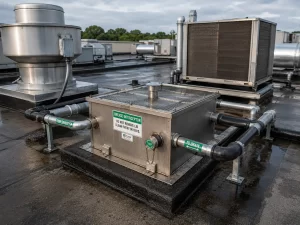
Best Grease Containment Systems for Restaurants
In commercial kitchens, grease management is far more than a housekeeping concern.
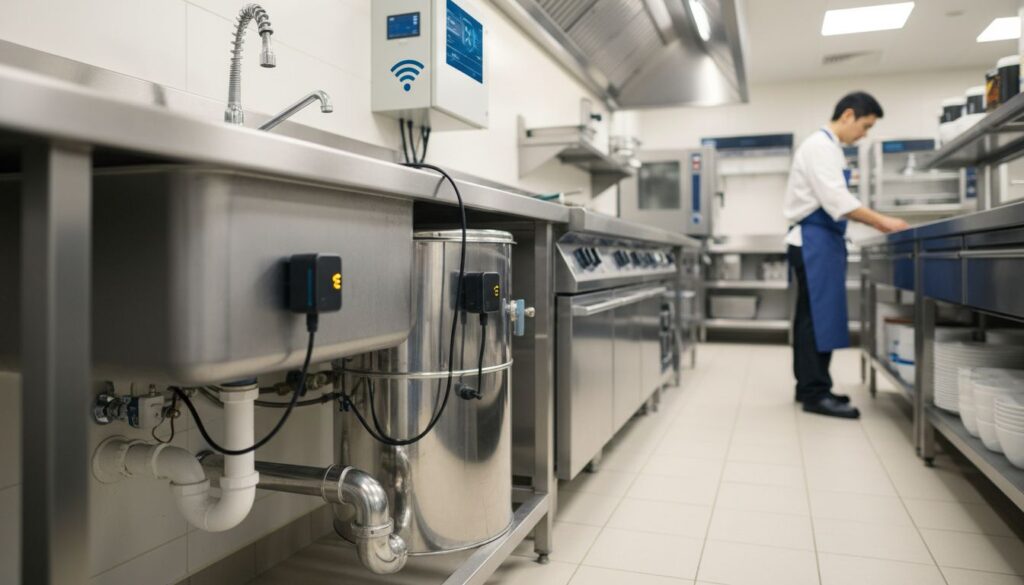
Restaurants facing stricter fats, oils, and grease requirements need more than a fixed pumping calendar: they need reliable proof that grease-control equipment is being maintained before it causes a sewer problem. Smart FOG sensors can help by tracking conditions in grease traps, interceptors, and related equipment, alerting staff as a cleaning threshold approaches, and creating a usable record of maintenance activity.
The technology is not a substitute for a properly sized grease-control device, a qualified cleaning provider, or the local ordinance. It is a practical layer of visibility in a regulatory environment where cities increasingly inspect equipment, require cleaning records, and measure compliance by equipment condition rather than by a restaurant’s best estimate.
Direct answer: Smart FOG sensors help restaurants meet FOG regulations by monitoring grease-control equipment, warning staff when grease and solids are nearing a maintenance threshold, and supporting electronic records of inspections, cleanings, invoices, and corrective actions. They work best when their alerts and reports are matched to the restaurant’s local grease-trap or interceptor requirements.
FOG regulations are designed to keep fats, oils, grease, and food solids out of public sewer systems. When grease cools and accumulates, it can restrict wastewater flow and contribute to blockages. Tempe warns that improper FOG management can create large “fatbergs” in the wastewater collection system, while New York City states that grease interceptors are needed to prevent grease from clogging sewer lines.
For a restaurant, the compliance task is usually operational: install the required device, keep it functioning, clean it often enough, retain the required documentation, and make records available during an inspection. Smart monitoring does not change those duties. Instead, it can reduce the gap between what staff believe is happening inside a buried interceptor or under-sink grease trap and what the equipment’s condition actually requires.
The exact data available depends on the sensor and installation. Restaurants should therefore distinguish between what their equipment can observe and what a local regulator requires as proof. An alert may be useful operationally, but an ordinance may still require a cleaning invoice, photographs, a manifest, or a city-provided maintenance log.
Local FOG programs are not uniform, but the direction is clear: regulators are formalizing expectations for grease-control equipment and documenting whether food service establishments follow them. Seattle says that businesses with commercial kitchen plumbing fixtures and a King County Food Business Permit must install a grease interceptor. Seattle also notes that noncompliance can lead to fines.
Installation alone is not the finish line. Portland inspects grease interceptors to determine whether they are being pumped frequently enough, and its FOG program includes reporting cleanings after proper cleaning. San Francisco assigns food service establishments a discharger category, notifies them of compliance requirements, and provides maintenance logs for grease traps and interceptors.
These programs make documentation part of everyday restaurant operations. Norfolk, for example, requires restaurants in its FOG program to email before-and-after cleaning photos, cleaning invoices, and used cooking oil manifests. A restaurant that cleans equipment correctly but cannot quickly locate the supporting documents may still face avoidable administrative friction.
Smart sensors are relevant because they can fit around this workflow. They can associate an equipment alert with a work order, prompt staff to confirm service, and preserve a time-stamped operational history. That does not mean sensor data automatically replaces city-required documents. It means the restaurant has a more organized basis for requesting, attaching, and retaining the documents its program demands.
Some ordinances define maintenance in measurable terms rather than simply prescribing a universal schedule. Salt Lake City says a grease trap must be cleaned as frequently as needed when FOG and food solids exceed 25% of capacity. That approach makes routine observation essential: the right cleaning interval can vary by menu, volume, kitchen practices, device size, and actual accumulation.
In that setting, continuous or frequent monitoring is a logical operational response. It can help a restaurant identify when equipment is approaching its applicable threshold rather than waiting for a monthly, quarterly, or otherwise fixed service date that may be too late or unnecessarily early.
Many restaurants have historically managed grease traps and interceptors with a recurring pumping schedule. That is simple to administer, especially when a waste hauler or service provider visits on a set interval. The weakness is that a fixed schedule does not always reflect what is happening inside the equipment.
A high-volume restaurant, a menu with more fried food, a seasonal surge, or inconsistent kitchen practices can increase accumulation between visits. Conversely, an operation may pay for service before the device is nearing a condition that requires it. Portland’s focus on whether interceptors are pumped often enough to prevent FOG bypass and Salt Lake City’s capacity-based cleaning rule both illustrate why “we pump on the usual date” may not be the most useful compliance standard.
This process is predictive maintenance in a practical sense: the restaurant uses equipment condition to plan intervention before an avoidable problem occurs. The benefit is not a promise that sensors prevent every blockage. It is earlier warning and better scheduling when the alternative is periodic manual checking or an inflexible pump-out cycle.
Sensor data can strengthen a restaurant’s operational story. It may show that the site monitors a specific device, received an alert, scheduled maintenance, and recorded completion. During an inspection, that history can be easier to retrieve than scattered emails, handwritten notes, or a manager’s memory.
However, a sensor is not automatically a regulatory record. Local programs set their own evidence requirements. Norfolk’s required package of before-and-after cleaning photos, invoices, and used cooking oil manifests is a clear example of why a restaurant should not assume a dashboard alone satisfies documentation rules.
A useful digital compliance file should combine sensor information with the records that the jurisdiction explicitly requests. The goal is not to overwhelm an inspector with data. It is to provide clear, relevant evidence in a format the local program recognizes.
San Francisco’s use of discharger categories, checklists, and maintenance logs shows that compliance systems can be structured and facility-specific. A multi-unit operator should avoid treating one city’s log format or cleaning rule as a universal template. The sensor platform should be flexible enough to preserve location-specific requirements.
Electronic reporting also aligns with a broader regulatory direction. EPA’s CROMERR program provides a legal framework for electronic reporting under EPA regulatory programs and for state, tribal, and local partners. That framework does not create a restaurant-specific sensor mandate, but it supports the wider move toward electronic compliance processes.
The best monitoring approach begins with the grease-control technology required or permitted at the site. Connecticut’s statewide program recognizes several options for certain food service dischargers: an outside grease trap/interceptor, an active grease recovery unit (AGRU), or a super-capacity grease interceptor (SCGI). That recognition matters because restaurants may not all have the same equipment, access conditions, or maintenance workflow.
Before selecting a smart sensor, confirm what is installed and what the local regulator expects. A sensor that is well suited to one interceptor design may not be appropriate for another device or for an AGRU. The purchase decision should follow, not replace, engineering, plumbing, and regulatory due diligence.
It is also wise to involve the people who will use the system every day: the kitchen manager, facilities lead, maintenance provider, finance or accounts-payable team, and the person responsible for inspection records. If an alert arrives but no one owns the next step, the technology becomes another unattended notification channel rather than a compliance tool.
Restaurants should be especially cautious about vendor claims that imply guaranteed regulatory acceptance. The authority on what constitutes compliance is the applicable sewer-use ordinance, FOG program, utility, or environmental agency. A vendor can explain system capabilities; the restaurant must verify whether its planned process meets local requirements.
Manual grease checks take time and can be inconsistent, particularly when equipment is difficult to access or when managers are balancing service, staffing, inventory, and food safety work. Smart FOG sensors can reduce some of that labor by making equipment condition more visible between in-person inspections.
The operational value is strongest when alerts change a decision. Instead of sending staff to check every unit on a routine basis or arranging service solely because a date has arrived, managers can prioritize the locations and devices that need attention. Portland’s emphasis on pumping often enough to avoid FOG bypass and Salt Lake City’s 25% capacity threshold both support the logic of matching service frequency to actual conditions.
Condition-based maintenance may help restaurants avoid unnecessary service visits while also reducing the risk of waiting too long. The financial outcome will vary by device, service contract, restaurant volume, local fees, staffing model, and the effectiveness of the response process. Restaurants should evaluate savings using their own invoices and maintenance history rather than assuming a sensor will produce a fixed return.
There can also be value in being able to demonstrate compliance. EPA’s FOG guidance notes that New York City identified a 73% non-compliance rate with its grease-trap ordinance among restaurants and responded with a $1,000-per-day fine for violations. That example is not a prediction of penalties in other cities, but it illustrates why avoidable FOG failures can become expensive.
San Francisco also notes that qualifying restaurants can receive a 14.2% reduction on the sewer service charge portion of their water/sewer bill after installing grease-capturing equipment and submitting verification. That is a specific local program, not a general sensor incentive. Still, it shows that equipment verification and documented participation can have financial relevance beyond avoiding enforcement.
No monitoring system can compensate for poor source control. Grease-control equipment is a final barrier, not a reason to pour waste oil, food scraps, or wash-water heavy with grease into drains. The most resilient FOG program combines monitoring with daily kitchen procedures that limit what reaches the trap or interceptor.
Managers should make the response to an alert part of a broader operating standard. If the system repeatedly shows faster accumulation than expected, the restaurant should investigate kitchen behavior, menu changes, equipment use, cleaning methods, and service frequency rather than simply silencing notifications or raising the alert threshold.
These practices also make sensor readings more meaningful. A sudden change in accumulation can prompt a useful conversation: Was there an unusually busy period? Did kitchen procedures change? Was a device serviced incorrectly? Is the installed equipment adequate for current operations? Sensors provide a signal; trained staff and qualified service professionals interpret that signal in context.
Smart FOG sensors are not a universal replacement for manual inspection, pumping, or local reporting. They require an upfront investment, suitable installation conditions, ongoing attention to alerts, and a defined response process. Restaurants also need to account for connectivity, data access, hardware maintenance, and staff training.
Most importantly, the local rule remains controlling. Seattle’s enforceable grease-interceptor requirements, Portland’s inspection and cleaning-reporting process, Norfolk’s documentation requirements, San Francisco’s category and log system, and Salt Lake City’s condition-based threshold show that compliance details vary substantially by jurisdiction.
A small operation with one accessible grease trap, stable volume, reliable service records, and a straightforward local requirement may decide that disciplined manual checks and scheduled cleaning are sufficient. In that case, a digital maintenance log, calendar controls, and careful document storage may solve the immediate compliance problem without installing connected hardware.
Sensor adoption becomes more compelling when a restaurant has multiple locations, hard-to-access equipment, changing volumes, repeated maintenance surprises, a history of missed paperwork, or a local program that emphasizes condition-based cleaning and inspection-ready records. The decision should be based on operational risk and workflow complexity, not technology for its own sake.
FOG rules remain an active policy issue. Miami-Dade introduced a 2026 measure to study whether its FOG regulations can be implemented or enforced in a less financially burdensome way for local businesses. The measure does not establish a universal new requirement, but it is a reminder that restaurant operators should monitor local developments rather than assuming today’s process will always be sufficient.
EPA’s FOG management materials state that sewer-use ordinances should include FOG program regulations or reference a formal FOG management policy or ordinance. For restaurants, that means the first source of truth is the current local program. Read the ordinance and utility guidance, then design technology and maintenance workflows around those requirements.
Smart FOG sensors are most useful when they turn FOG compliance from a reactive chore into a managed process: monitor equipment, act before capacity or bypass becomes a problem, and retain the evidence the local program requires. They can reduce reliance on guesswork and routine manual checks, but they do not remove the need for proper equipment, service, and source-control practices.
For restaurant operators, the practical next step is to compare local FOG rules with the records and maintenance data already available at each site. Where gaps exist, a connected monitoring and documentation workflow can help make grease interceptor maintenance more predictable, inspection-ready, and aligned with evolving FOG regulations.
In commercial kitchens, grease management is far more than a housekeeping concern.

In commercial kitchens, grease rarely stays where it belongs. While many restaurant

Ease of access is really important in commercial cooking operation exhaust cleaning.

At Omni Supply we enjoy working shoulder to shoulder with our distributors

If you have a commercial restaurant, chances are you have a grease
Service and safety providers in the restaurant servicing industry often concentrate their
Your main goal as a commercial restaurant owner or manager should be
I am amazed and surprised when I see business owners posting online
Knowing the process for creating and updating the standards provides a foundation
Are you a Commercial Kitchen Exhaust Cleaner, Roofing or HVAC Contractor?
Contact us for your discounted pricing.